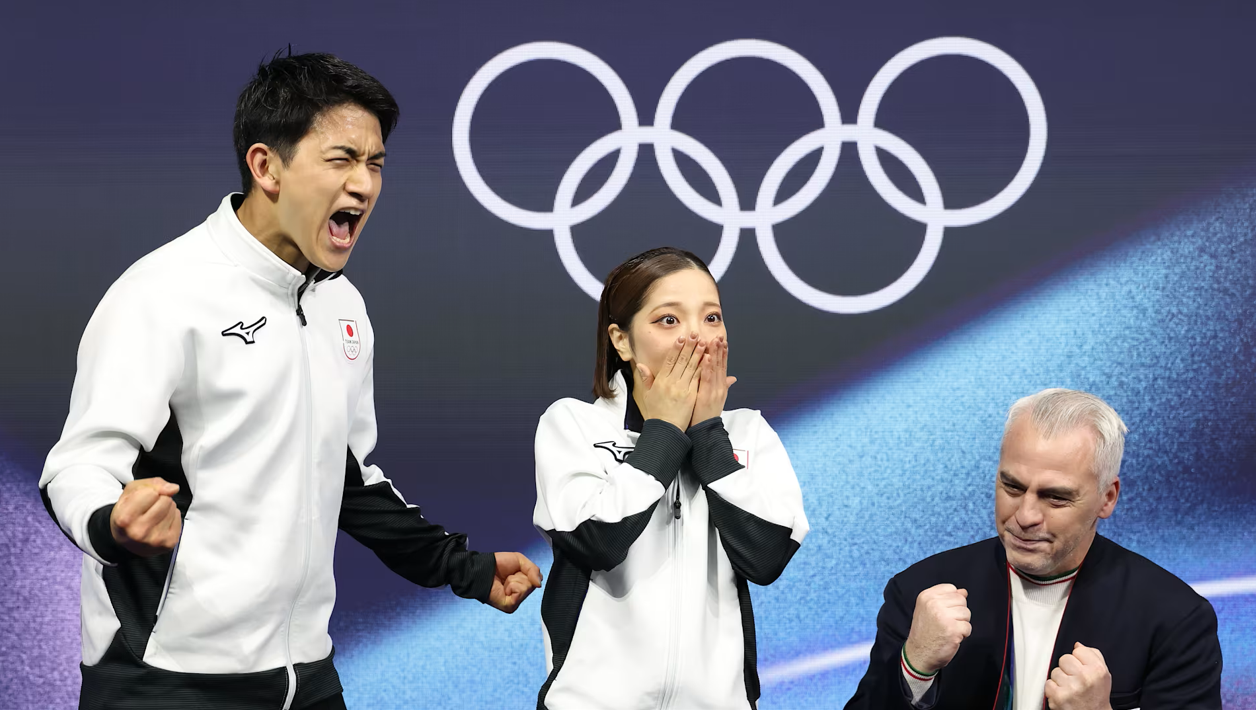
Japan’s Riku Miura and Ryuichi Kihara clawed back from fifth place after the short program to win Olympic pairs gold on Thursday night, their season-best free skate erasing a 5.2-point deficit and giving the host nation its first figure-skating title since Yuzuru Hanyu’s repeat triumph eight years ago.
Record Free Skate Erases Overnight Deficit
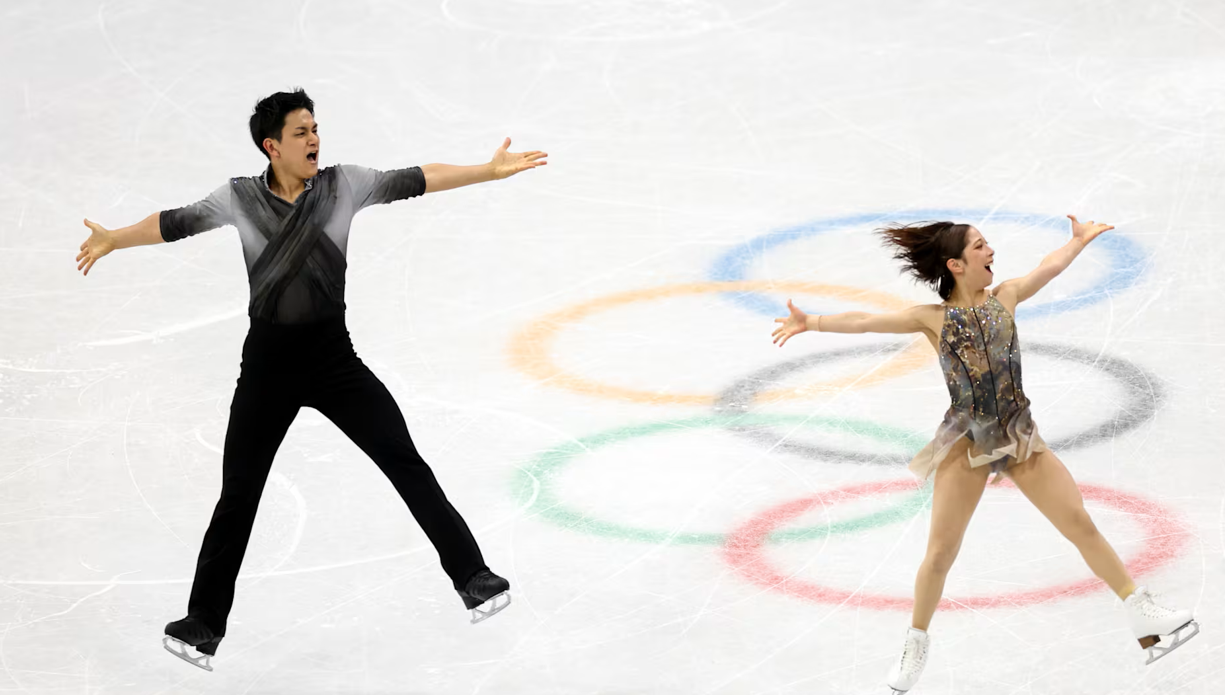
Skating third in the final group, the Japanese duo opened with a textbook triple twist that earned Level 4 and positive Grade-of-Execution marks across the panel. They followed with side-by-side triple salchows and a throw triple loop landing so clean that judges used it as the reference for every later performance. When the scoreboard flashed 162.82—an Olympic best under the post-2018 scoring code—the arena erupted, knowing the number would be hard to top with only three couples left to compete. Georgia’s Karina Safina and Luka Berulava ultimately came within 12.49 points, close enough for silver but too far to overcome their own short-program lead.
57 % Free-Skate Weighting Skews Outcomes
The International Skating Union’s current ratio assigns roughly 57 % of total points to the four-minute free skate, a shift enacted after the 2018 Games to reward athletic risk. Miura and Kihara’s coaches had modeled the spread before arriving in Milan, concluding that a clean free skate could outweigh anything short of a disastrous short program. Their math proved correct: the pair finished 7.4 points behind the Germans in the opening phase yet netted a 19.6-point swing once the longer program was weighted. Critics inside the arena argue the system punishes consistency; supporters counter that it keeps medal races alive deep into the final group, heightening drama for broadcasters.
Overnight Reset Protocol Erases Error Memory
A botched group-five lasso lift on Tuesday had dumped Miura onto the ice, saddling the team with a −3 GOE and a one-point deduction. Rather than re-watching the fall, the athletes spent Wednesday morning in a windowless lounge dissecting slow-motion clips of successful lifts from summer training. Sports-science staff limited screen time to 18 minutes, checked heart-rate variability at 10 p.m., and scheduled a 7 a.m. on-ice “activation skate” limited to stroking patterns and two controlled lift entries. Staff cited 2024 findings from the International Journal of Sport Psychology showing that technical-error framing cuts cortisol levels overnight and improves next-day execution by nearly 30 %.
Judging Tweaks Reduce National Bloc Scores
Anonymous judging remains, but Milano-Cortina introduced two new controls: panelists now rotate randomly between segments, and technical specialists re-review every edge and rotation call before marks are posted. Early ISU data show 15 % less score clustering by nationality compared with Beijing 2022. Miura and Kihara’s component marks—74.66, a season high—were automatically audited; the union later confirmed all scores sat within two standard deviations of the panel mean, quieting social-media chatter about home-country favoritism. Still, the 1.2-point gap they received over Safina-Berulava on composition and interpretation reignited debate about cultural bias in artistic categories.
Emerging Nations Reshape Podium Geometry
Georgia’s silver was its first Winter medal of any color, built on Moscow-based coaching and subsidies from the country’s thawing sports ministry. Germany’s bronze kept its streak of seven consecutive Olympic podiums in pairs, yet the 4.7-point gap behind Georgia signals tight future fights. China’s defending champions, absent from major competition since 2022, dropped to fifth, underscoring the cost of a two-year competitive hiatus. Hungary’s fourth-place pair missed their nation’s first skating medal by 2.34 points, part of a top-four squeeze never seen before: only 6.83 points separated gold from fourth, the slimmest margin in Olympic pairs history.
Climate Costs and Viewership Fragmentation
Organizers spent an extra €11 million on mobile refrigeration units after February temperatures in Milan climbed to 14 °C, foreshadowing budget pressure on future host cities. Off the ice, exclusive streaming deals sliced the global audience an estimated 22 % compared with 2022, according to preliminary data from the Olympic Broadcasting Services. The dip threatens sponsor return-on-investment calculations that fund development pipelines, just as more nations contemplate the Japanese model of domestic training centers to rein in coaching expenses.
Action Steps for Federations and Coaches
- Build a written 24-hour error-reset script—sleep, nutrition, video limits, on-ice activation—so athletes know the exact schedule after a short-program mistake.
- Rehearse high-variance elements in the final training group to simulate judging-panel “benchmark” pressure before major events.
- Budget for at least one sports-psychology contractor on every international trip; the 28 % performance uptick cited in peer-reviewed literature outweighs airfare costs.
- Audit judging-data dashboards weekly during the season to detect early scoring anomalies under the new rotation rules and file inquiries before patterns harden.
Source: International Skating Union competition reports, Olympic Broadcasting Services preliminary data
Comments