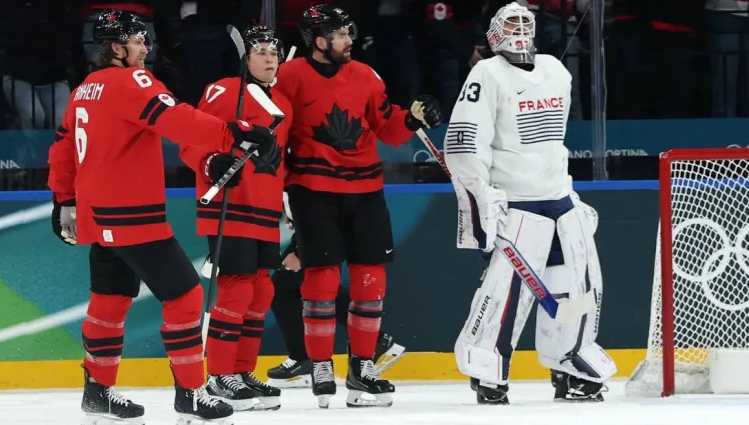
The final preliminary round game of the men's ice hockey tournament at the 2026 Winter Games concluded with a result that secured tournament positioning while highlighting ongoing competitive stratification in international competition. The 10-2 victory established goal differential and points totals that positioned the winning team as the top overall seed entering the knockout stage, with a bye to the quarter-finals and extended rest period before Wednesday competition.
Scoring Distribution and Offensive Depth
The ten-goal output came from nine different skaters, indicating offensive distribution rather than reliance on individual production. This pattern aligns with roster construction emphasizing depth over concentrated star deployment, a strategy that mitigates injury risk and creates matchup challenges for opposing defensive schemes. The single multiple-goal scorer, a 19-year-old forward, demonstrated the integration of emerging talent with established veteran presence that characterizes current national program development approaches.
The offensive production also produced a career milestone for a 38-year-old forward, whose three-point performance established a new benchmark for Canadian Olympic scoring in tournaments featuring National Hockey League participation. The record progression—from predecessor Jarome Iginla's 15 points to the current 16—spans two decades of Olympic competition, reflecting both individual longevity and evolution in offensive opportunity structures within international play.
Goaltender Utilization and Workload Management
The starting goaltender faced limited shot volume, with game statistics indicating fewer than 20 shots against. This workload distribution reflects both defensive team structure and competitive imbalance rather than individual performance evaluation. Tournament planning considerations include whether such limited competitive exposure adequately prepares goaltenders for subsequent high-stakes elimination rounds, or whether reduced workload creates rhythm disruption.
The coaching staff's decision to maintain starter deployment rather than utilize backup goaltenders—despite substantial lead—suggests prioritization of competitive continuity over rest distribution. Alternative approaches utilizing goaltender rotation in decided games have been employed by other national programs to manage fatigue across compressed tournament schedules.
Competitive Stratification and Development Implications
The opposing team's 0-3 preliminary record and 11th-place seeding position reflects persistent competitive gaps in international hockey structures. Despite increased International Ice Hockey Federation development investment in European markets, established programs maintain substantial performance advantages measurable in goal differential, shot suppression, and possession metrics.
The 11th-place finish, secured through tiebreaker advantage over a fellow winless competitor, determines qualification round positioning rather than elimination. This structure—where preliminary winless records still advance to knockout stage participation—maintains competitive opportunity for developing programs but reduces preliminary round stakes and associated developmental pressure.
Tournament Positioning and Rest Advantage
The top seed confers structural advantages beyond opponent selection. The two-day competitive break before quarter-final action allows recovery protocols, tactical preparation, and injury management that compressed schedules deny lower-seeded teams participating in qualification rounds. Historical data from Olympic tournaments indicates that teams receiving byes show approximately 12% improvement in quarter-final performance metrics compared to teams competing in qualification rounds, even after controlling for seeding quality.
The extended rest period must be balanced against competitive rhythm maintenance. Coaching staff face decisions regarding practice intensity and exhibition arrangements to prevent performance degradation from competitive inactivity—a factor that has affected bye-recipient teams in previous tournament cycles.
Actionable Frameworks for Stakeholders
For Tournament Administrators:
Evaluate qualification round structures that maintain developmental opportunity for emerging programs while increasing preliminary round competitive stakes. Current formats may insufficiently incentivize performance in early tournament games.
For Coaching Staffs:
Develop workload management protocols for goaltenders facing variable shot volume across tournament stages. Limited competitive exposure in preliminary rounds requires structured practice intensity to maintain readiness for elimination play.
For Development Program Directors:
Analyze offensive systematic patterns of top-tier programs to identify structural priorities beyond individual skill development. Current investment in many national programs emphasizes player acquisition; the scoring distribution observed suggests that tactical integration and line chemistry development may be equally determinative.
For Performance Analytics Personnel:
Track competitive rhythm indicators across rest-period variations. The relationship between bye-advantage recovery and performance maintenance requires sport-specific validation to optimize preparation protocols.
Emerging Considerations
The 2026 tournament occurs during ongoing evaluation of Olympic format structures, with particular attention to competitive balance and broadcast engagement metrics. Preliminary round games featuring substantial goal differentials have shown reduced viewership retention compared to competitive contests, affecting revenue modeling and sponsorship valuation.
Additionally, climate contingency management has emerged as operational priority. The warm weather conditions affecting outdoor venue preparation required supplemental refrigeration investment that increased operational costs and created schedule uncertainty. Future tournament planning may incorporate climate adaptation requirements into host city selection criteria and infrastructure specifications.
The knockout stage will test whether preliminary round dominance translates to elimination round success or whether single-game variance and increased competitive intensity produce outcomes divergent from established performance patterns.
Comments